Whether you're a small business owner issuing monthly payslips or an employee who has misplaced a pay stub for a loan application — generating a salary slip online is faster and easier than most people think. This guide covers everything: what a salary slip must legally contain, how the numbers are structured, and how to generate one in under two minutes.
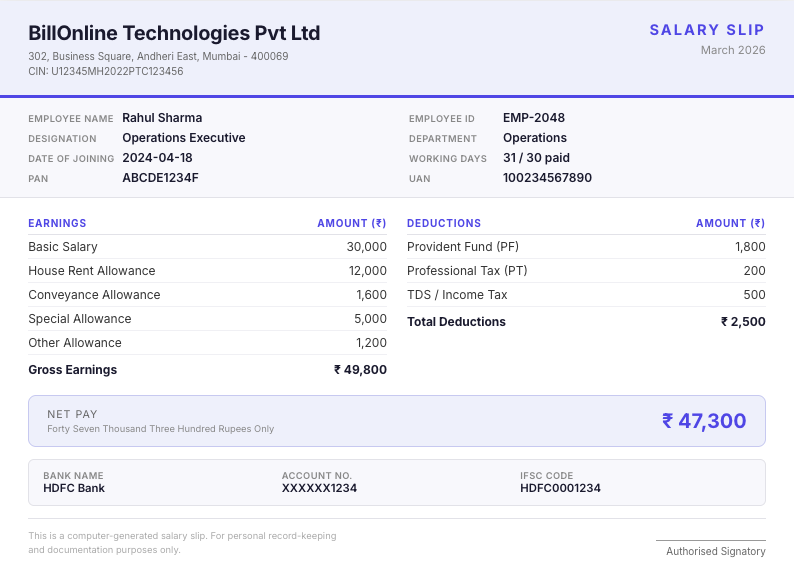
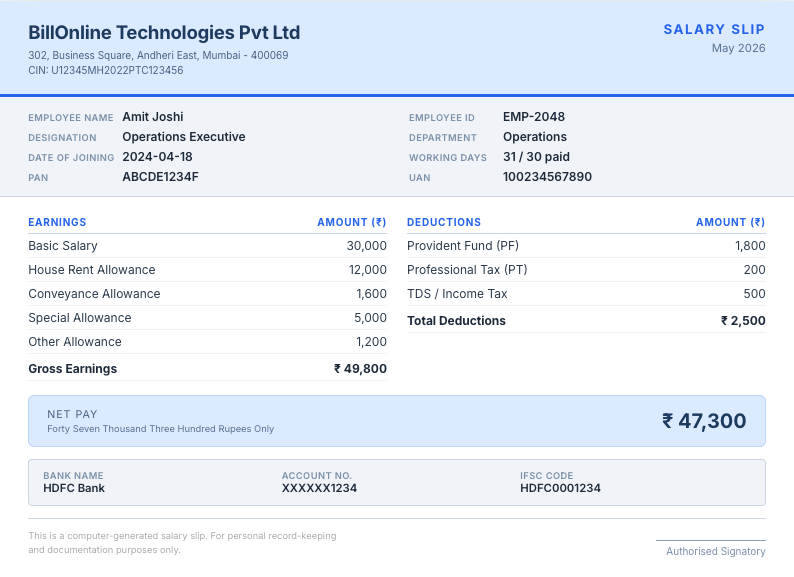
Generate a professional salary slip instantly — no login, no fees.
Generate Salary Slip Free →What is a Salary Slip?
A salary slip (also called a payslip or wage slip) is a document issued by an employer to an employee every month that details the breakdown of earnings and deductions for that pay period. It is both a legal requirement and a critical financial document — used for loan applications, tax filing, visa applications and job changes.
Under the Payment of Wages Act 1936 and various state-level Shops & Establishments Acts, every employer must provide employees with a written wage slip. For most salaried employees in India, this arrives by email as a PDF each month.
Components of an Indian Salary Slip
A standard Indian payslip is divided into two sections: Earnings (what you receive) and Deductions (what is subtracted). Here is a breakdown of the most common components:
Earnings Side
| Component | What It Is | Typical % of Basic |
|---|---|---|
| Basic Salary | Core fixed pay — base for all other calculations | 40–50% of CTC |
| HRA | House Rent Allowance — partially tax-exempt for tenants | 40–50% of Basic |
| DA | Dearness Allowance — cost-of-living adjustment (common in govt/PSU) | Varies |
| TA / Conveyance | Transport Allowance for daily commute | Fixed amount |
| Special Allowance | Balancing component — fully taxable | Remainder of CTC |
| LTA | Leave Travel Allowance — tax-exempt twice in 4-year block | Fixed amount |
| Bonus / Performance Pay | Variable pay — shown in the month it is paid | Varies |
Deductions Side
| Deduction | What It Is | Rate |
|---|---|---|
| Employee PF | Provident Fund — retirement savings (EPF) | 12% of Basic (capped at ₹1,800/mo for many) |
| Professional Tax | State-level tax on employment income | Up to ₹200/mo (varies by state) |
| TDS on Salary | Income tax deducted at source based on your tax slab | Varies by income |
| ESI | Employee State Insurance — for employees earning ≤ ₹21,000/mo | 0.75% of gross |
| Other deductions | Advances, loans, LWP (loss of pay) | As applicable |
Net Salary = Gross Earnings − Total Deductions. This is the amount that gets credited to your bank account. Gross salary is your earnings before any deductions.
Why Do You Need a Salary Slip?
A payslip is required in more situations than most employees realise:
- Loan applications — banks ask for 3–6 months of payslips for personal loans, home loans and car loans
- Credit card applications — issuers verify your income level
- Visa applications — embassies require proof of employment and income
- Job changes — new employers ask for last 3 months of payslips to verify salary history
- Tax filing — payslips help reconcile Form 16 and calculate TDS already paid
- HRA tax exemption claim — Basic salary figure on payslip determines HRA exemption limit
- PF claims and transfers — needed to verify contribution history
How to Generate a Salary Slip Online (Free)
BillOnline's Salary Slip Generator lets you create a professional payslip in under two minutes — no account, no watermark, no fees. Here's how:
- Enter company details — company name, address, logo (optional)
- Enter employee details — name, employee ID, designation, department, date of joining
- Set the pay period — select month and year
- Fill in earnings — Basic, HRA, DA, Special Allowance, and any other components
- Fill in deductions — PF, Professional Tax, TDS, ESI
- Preview and download — the tool calculates Gross, Total Deductions and Net Salary automatically. Save as PDF directly from your browser.
Ready to generate your payslip? It takes under 2 minutes.
Open Salary Slip Generator →Salary Slip Format — What Does a Standard Payslip Look Like?
A well-formatted salary slip typically follows this layout:
- Header — Company logo, name, and address
- Employee info block — Name, Employee ID, Designation, Department, PAN, Bank Account (last 4 digits), PF UAN
- Pay period — Month, Year, Days Worked / LWP
- Earnings table — Component-wise breakdown of all allowances
- Deductions table — PF, PT, TDS, ESI
- Summary row — Gross Earnings | Total Deductions | Net Pay
- Footer — "This is a computer-generated payslip and does not require a signature"
CTC vs Gross vs Net Salary — The Most Confused Terms
These three terms trip up even experienced professionals:
- CTC (Cost to Company) — Total annual cost the employer bears, including employer's PF contribution, gratuity provision, and any other benefits. This is what your offer letter shows.
- Gross Salary — Monthly earnings before deductions. Does NOT include employer PF or gratuity. CTC ÷ 12 is not your gross salary.
- Net Salary (Take-Home) — Gross minus all employee deductions. This hits your bank account.
Example: CTC ₹10,00,000/year → Monthly CTC ₹83,333 → Gross Salary ₹75,000 (after removing employer PF ₹1,800, gratuity ₹3,205, etc.) → Net Pay ₹65,000 (after employee PF ₹1,800, PT ₹200, TDS ₹8,000).
PF Calculation on Salary Slip
Provident Fund (EPF) is calculated on Basic + DA only, not on gross salary. The employee contributes 12% of Basic+DA, and the employer contributes another 12% (of which 8.33% goes to EPS — Employee Pension Scheme, and 3.67% to EPF).
For employees with Basic salary above ₹15,000/month, PF contribution is capped at 12% of ₹15,000 = ₹1,800/month — unless the employer opts for contribution on actual Basic. Both employee and employer must contribute to EPF if the organisation has 20 or more employees.
Professional Tax — State-wise Rates
Professional Tax (PT) is levied by state governments and deducted from salary. Key points:
- Maximum PT is ₹2,500/year (capped by the Constitution)
- Maharashtra: ₹200/month for salaries above ₹10,000 (₹300 in February)
- Karnataka: ₹200/month for salaries above ₹15,000
- West Bengal, Andhra Pradesh, Telangana: varying slab rates
- States like Delhi, Haryana, Rajasthan, UP do NOT levy PT
Frequently Asked Questions
Is a salary slip mandatory for employees in India?
Yes. Under the Payment of Wages Act 1936 and state-level Shops & Establishments Acts, employers must provide a written wage slip monthly. Small businesses that don't have payroll software often generate slips using free online tools like BillOnline.
Can I use a salary slip for a loan application?
Banks and NBFCs require the last 3–6 months of salary slips for loan applications. The slip must clearly show employer name, employee details, gross salary, all deductions, and net pay. A salary slip generated on BillOnline includes all required fields.
What if I am paid in cash — do I still need a salary slip?
Yes — if your employer pays you in cash, they are still legally required to provide a wage slip. The slip serves as documentation of your employment income. For self-employed individuals or freelancers, a salary slip is replaced by ITR, bank statements, and invoices for loan purposes.
How is HRA calculated on a salary slip?
HRA is a fixed component on your salary slip — typically 40% of Basic (non-metro) or 50% of Basic (metro cities). The tax exemption on HRA is calculated separately based on actual rent paid, HRA received, and city of residence. Your payslip shows HRA received; your employer's Form 16 shows the exempt portion.